
Dr Tomasz-Łukasz Stanowski

history of ideas, social and political philosophy, idealisms, romanticisms, conservatisms, Lebensphilosophie, political theology, digital humanities

Research Profile

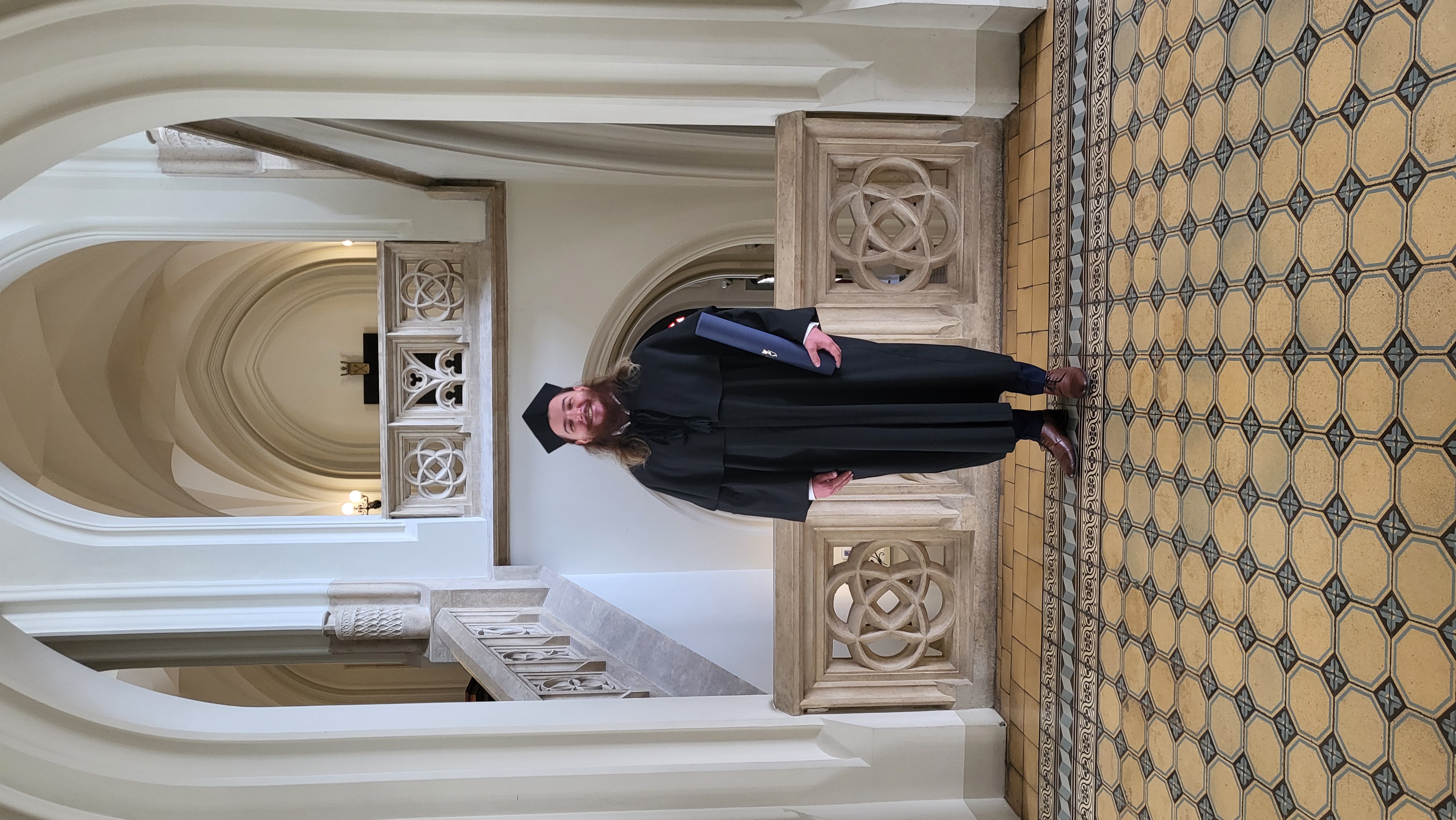
Portrait of Dr Tomasz-Łukasz Stanowski in academic gown

I am a philosopher and historian of ideas working on Polish and German philosophy, the history of idealism, Romanticism, and conservatism, as well as social and political philosophy, political theology, and Lebensphilosophie. I am concerned, above all, with the ways in which philosophical ideas exceed the bounds of system and begin to act within culture, religion, the language of community, the political imagination, and historical forms of collective life.

Józef Gołuchowski occupies a central place in my work. In studying his thought, I seek to reconstruct not only his system and intellectual formation, but also the broader process by which German philosophy was received in Poland—especially at those points where metaphysics, the philosophy of religion, and reflection on freedom open onto questions of community, moral order, education, nationhood, and the spiritual foundations of social life. In this sense, my work concerns both the history of ideas and the history of the concepts, languages, and practices through which communities come to interpret themselves.

My research brings together the close reading of primary texts, archival work, and comparative analysis with reflection on historicity, experience, and spiritual life. For that reason, Lebensphilosophie and the hermeneutics of life remain important points of reference for me—not only as objects of study, but also as significant idioms for interpreting modernity, culture, and historical self-understanding. I am especially interested in those moments at which philosophy comes into contact with forms of life, communal ethos, historical memory, and the tension between the metaphysical, the social, and the political.

At the same time, I am deliberately expanding my scholarly toolkit to include digital humanities, artificial intelligence, data analytics, and data-driven approaches. I regard these not as substitutes for classical humanistic practice, but as its deliberate extension: tools that support work with archives, manuscripts, text corpora, the comparison of materials, and the organisation of complex source environments. I am equally interested in their application within broader social, institutional, and research contexts—where philosophical reflection encounters new ways of producing, analysing, and communicating knowledge.

I currently pursue my research as an independent scholar beyond institutional structures.

Research Areas and Objectives

The Reception of German Idealism in Poland — Schelling, Romanticism, Catholic and conservative traditions, and their impact on the categories of freedom, community, moral order, and socio-political order.

The Philosophy of Józef Gołuchowski — Reconstruction of his system, intellectual formation, and sources; study of the passage from metaphysics to social, political, and moral practice; analysis of the Polish reception of Plato and German Idealism.

Social and Political Philosophy and Political Theology — Research on the ideas of community, nation, religion, the “inner constitution”, the common good, and the symbolic and spiritual foundations of collective life.

Lebensphilosophie, the Hermeneutics of Life, and Historicity — Analysis of the categories of life, experience, spirituality, and historical self-understanding in dispute with positivism, and of their impact on the intellectual culture of Central Europe.

Digital Humanities, AI, and Data Analytics in Humanistic Research — The use of digital tools, artificial intelligence, and data-driven thinking in work on sources, archives, text corpora, the organisation of knowledge, and new ways of conducting and communicating research.

Forthcoming

  1. Constitutions without a State: Polish Political Theologies of the ‘Inner Constitution’ and the Common Good, 1830–1880 — International Conference: Political Theologies of Constitutions, the Rule of Law, and the Common Good, University of Cambridge, Cambridge, 23–25 April 2026.
  2. Translating the Ungrund: Semantic Friction in the Early Polish Mediation of Schelling’s Freedom (c. 1803–1864) — International Conference: History of Philosophy Society (HOPS) Annual Conference: Friction, University of California, Berkeley, 1–2 May 2026.
  3. Polish Catholic Schellingianism? Church Archives, Vatican Indexes, and the Reception of Schelling in Poland, 1820–1864 (Polski schellingianizm katolicki? Archiwa kościelne i indeksy watykańskie a recepcja Schellinga w Polsce (1820–1864)) — National Conference: 13th Seminar of Historians of Polish Philosophy, Nicolaus Copernicus University, Toruń, 28–30 May 2026.
  4. Ungrund as the Metaphysical Condition of Normativity: From Nature’s Dark Ground to Spirit’s Law (Schelling after Böhme) — International Conference: North American Schelling Society – NASS 9: Spirit and Nature, Metropolitan Autonomous University, Iztapalapa Campus, Mexico City, 3–5 June 2026.
  5. Inner Constitution and the Grammar of Legitimacy: Weber and Jaspers on Authority, Ethics, and Understanding — International Conference: Karl Jaspers and Max Weber, Karl Jaspers Society of North America, 29 June 2026.
  6. Repairing the Semiosphere of Legality: Constitutional Memory and a Semiotic Ethics of Recovery in a Stateless Public Sphere, 1830–1880 — International Conference: Societas Ethica – 62nd Annual Conference 2026, University of Tartu, Tartu, 20–23 August 2026.
  7. How Hegel Won—and Why We Are in Trouble: Polish Conservative Anti-Hegelianism and the Metaphysics of Contemporary Crises — International Conference: 36th International Hegel Congress 2026 – “Hegel Global”, Roma Tre University, Rome, 1–4 September 2026.

Publications in Preparation and in Circulation (2026–2027)

1. Invitations to contribute to post-conference publications

  1. Populism, Symbolic Violence, and Synodality: A Comparative Study of the Pontificates of John Paul II and Pope Francis.
  2. Metaphysics of Order in Catastrophe: Gołuchowski, Political Theology, and Historical Fictions of the Anthropocene.
  3. Between Order and Irony: Rorty’s Liberal Democracy in the Mirror of Polish Romantic Conservatism.
  4. Substantial Motion and the ‘Deed of History’: Mullā Ṣadrā and Nineteenth-Century Polish Historiosophy.

2. Articles submitted to international journals (in preparation)

  1. Non-Deterministic Materialism Revisited: Habermas on Schelling’s Nature and a Polish Romantic Counter-Laboratory of Social Cohesion, Revista Portuguesa de Filosofia (special issue: the 250th anniversary of F. W. J. Schelling).
  2. A Platonic Politeia without a State: Polish Uses of Plato in Debates on Moral Constitution and Legitimacy under Partition, c. 1830–1880, Studies in East European Thought.
  3. Partitioned Poland as a European Conceptual Laboratory: ‘Inner Constitution’, ‘Moral Constitution’, and the Problem of Legitimation without Sovereignty, History of European Ideas.

Biography

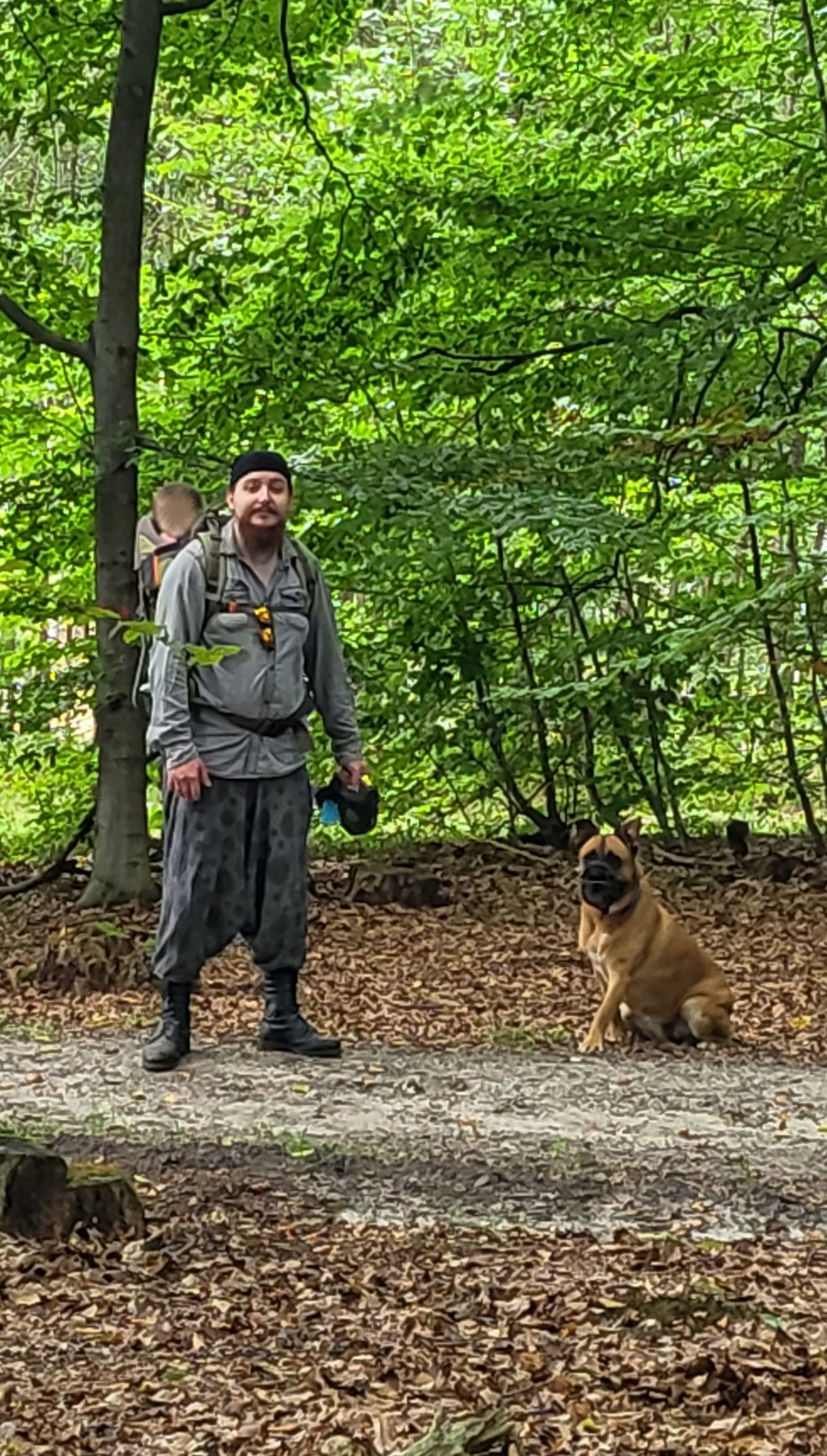
Portrait photograph of Dr Tomasz-Łukasz Stanowski

I was born on 12 March 1990 in Tarnów into a family marked by deep pedagogical and artistic traditions. My mother devoted her life to teaching, while my father—formerly a pedagogue and resocialisation educator—turned to the visual arts: sacred and portrait painting, drawing and printmaking, sculpture, stained glass, and the design of liturgical interiors.

From 2003 to 2009 I attended the Artur Grottger Secondary School of Fine Arts in Tarnów. Having completed diploma projects in sculpture, photography, and artistic joinery, and having passed the examination in art history, I was awarded the professional qualification of visual artist, with specialisations in design and artistic furniture-making.

My work there was recognised with the Prime Minister’s Scholarship on two occasions (2006/2007 and 2008/2009), as well as with the Archbishop Jerzy Ablewicz Foundation Scholarship (2007/2008).

After completing secondary school, I began studying engineering at the Faculty of Civil Engineering of the Cracow University of Technology (2009–2011), which I eventually left in order to devote myself fully to philosophy.

From 2011 to 2014 I studied philosophy at the Jagiellonian University, completing a BA and an additional specialisation in Eastern Philosophy. I then continued to the MA, and between 2014 and 2016 I wrote, under the supervision of the late Professor Elżbieta Paczkowska-Łagowska, a dissertation entitled Dilthey’s and Nietzsche’s Conceptions of the Human Being (Diltheya i Nietzschego pogląd na człowieka), which was recommended for distinction.

In 2018 I took part in the 4th Summer School of Process Philosophy organised by the A. N. Whitehead Metaphysical Society; in the following year I obtained teaching qualifications through the Jagiellonian University’s Teacher-Training Programme.

Between 2019 and 2021, in the space of the former Auschwitz-Birkenau camp, I completed the postgraduate programme Totalitarianism–Nazism–Holocaust (the Auschwitz-Birkenau State Museum in cooperation with what was then the Pedagogical University of the National Education Commission in Kraków). My dissertation for that programme was entitled Was Gołuchowski an Anti-Semite? The Chosen Nation in the Conservative-Romantic Political Thought of the Philosopher from Garbacz (Gołuchowski antysemitą? Naród wybrany w konserwatywno-romantycznej myśli politycznej filozofa z Garbacza).

Almost in parallel, I completed the postgraduate programme Mediation and Other Methods of Alternative Dispute Resolution at the Faculty of Law and Administration of the Jagiellonian University (2020–2021).

From 2016 to 2023 I pursued doctoral studies at the Jagiellonian University’s Institute of Philosophy under the so-called old system, and twice received scholarships for the best doctoral students. During that period, in 2017, I organised the training course Polish Bibliography of the Estreichers (Bibliografia Polska Estreicherów) at the Estreicher Polish Bibliography Research Centre.

My professional path has been far from uniform, yet for precisely that reason it has proved broadly formative: it has included work as a graphic designer, copywriter, fundraiser, architectural assistant, monitoring-station operator for a security company, salesperson, baker, leaflet distributor, gardener, kitchen assistant, and driver (including both professional driving and taxi work). I continue to hold a professional goods-transport driving qualification (Code 95), as well as a valid full ADR certificate covering the transport of dangerous goods both in packages and in tanks, including Class 1 (explosives) and Class 7 (radioactive materials).

Teaching has occupied a particularly important place in this trajectory: I have taught ethics and philosophy in primary and secondary schools, and have also run philosophical workshops and a philosophical reflection club.

My interests centre on philosophy, literature, the history of ideas, and the study of religion. My publication record currently comprises 26 scholarly articles and 20 papers delivered at national and international conferences. I was the last doctoral student at the Jagiellonian University’s Institute of Philosophy under the so-called old system. Beyond academia, I am deeply attached to the arts and to martial disciplines—I have trained in aikidō, boxing, judo, muay thai, kendō, and arnis.

In private life, I am a husband and the father of three daughters. My everyday world is accompanied not only by my loving wife and children, but also by a faithful dog and numerous lizards.

Education and Qualifications

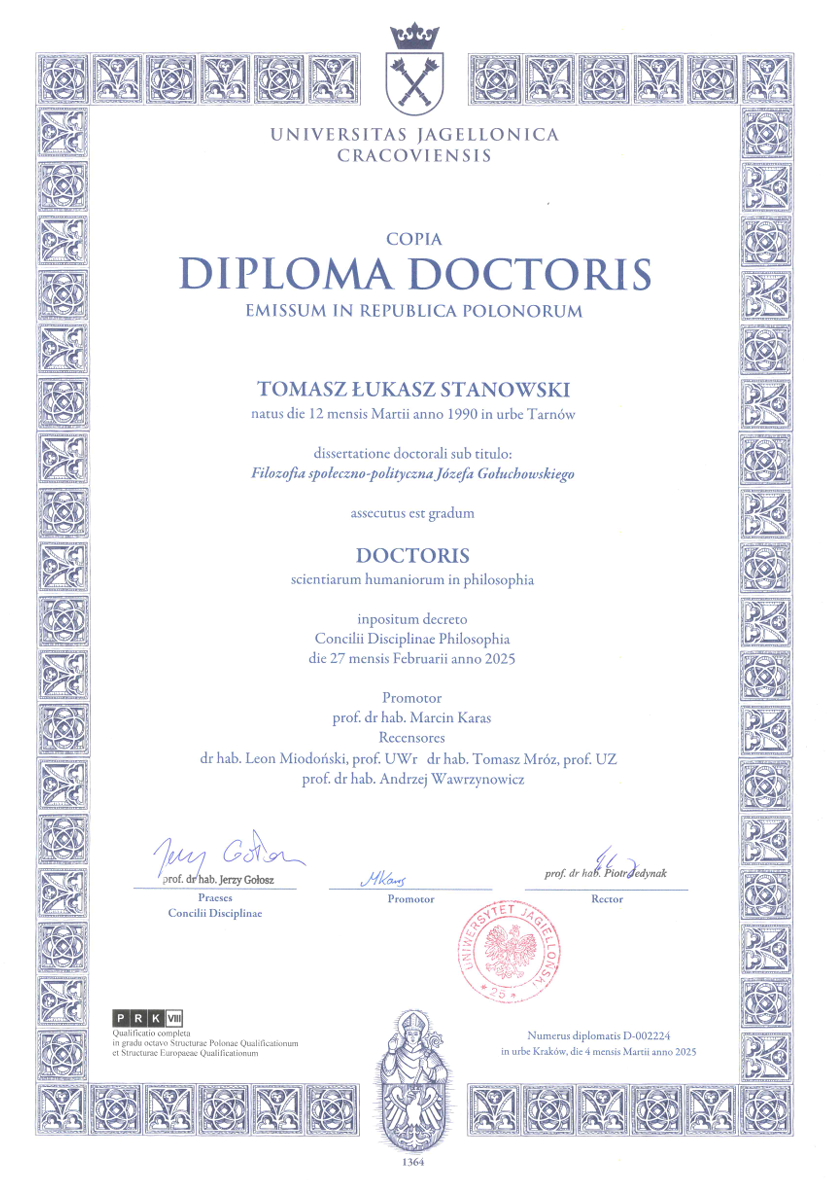
Doctoral diploma

Doctorate

27 February 2025 — awarded the doctoral degree in philosophy (humanities).

Academic Formation

2016–2023 — doctoral studies in philosophy, Faculty of Philosophy, Jagiellonian University.
2014–2016 — MA in Philosophy, Jagiellonian University.
2011–2014 — BA in Philosophy, specialisation in Eastern Philosophy, Jagiellonian University.

Postgraduate Studies, Qualifications, and Courses

2026–2027 — AI & Data Driven Business, postgraduate programme, Kozminski University.
2020–2021 — Mediation and Other Methods of Alternative Dispute Resolution, postgraduate programme, Faculty of Law and Administration, Jagiellonian University.
2019–2021 — Totalitarianism–Nazism–Holocaust, postgraduate programme, Auschwitz-Birkenau State Museum in cooperation with the Pedagogical University of Kraków.
2018 — 4th Summer School of Process Philosophy, A. N. Whitehead Metaphysical Society.
2015–2019 — Teacher-Training Programme, teaching qualifications, Jagiellonian University.

Secondary School

2003–2009 — Artur Grottger General School of Fine Arts in Tarnów, specialisation in design forms and artistic furniture-making.

Conference Papers

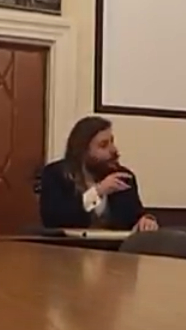
Photograph from a conference presentation
  1. Substantial Motion and the ‘Deed of History’: Mullā Ṣadrā and Nineteenth-Century Polish Historiosophy — International Conference: Seventh Annual Islamic Philosophy Conference, The American Society for Islamic Philosophy and Theology in cooperation with Brandeis University, Cambridge/Waltham, MA, United States, hybrid conference, 5–7 December 2025.
  2. Between Order and Irony: Rorty’s Liberal Democracy in the Mirror of Polish Romantic Conservatism — International Conference: Philosophy, Democracy and Conversation, The Richard Rorty Society in cooperation with the University of Buenos Aires, Buenos Aires, Argentina, 3–5 December 2025.
  3. The Metaphysics of Order in Catastrophe: Gołuchowski, Political Theology, and Historical Fictions of the Anthropocene — International Workshop: Historical Fiction in/and the Anthropocene, Historical Fictions Research Network, England/Worldwide, online, 29 November 2025.
  4. Populism, Symbolic Violence, and Synodality: A Comparative Study of the Pontificates of John Paul II and Pope Francis — International Conference: Populism, Nationalism, and the Future of Democracy, Journal for Cultural and Religious Theory in cooperation with the University of Denver, online, 26–27 September 2025.
  5. An Unwanted Classic of Polish Romanticism: Gołuchowski Revisited through the Archive (Niechciany klasyk polskiego romantyzmu. Gołuchowski archiwalnie odczytany) — National Conference: 12th Seminar of Historians of Polish Philosophy — Polish Philosophy between Classics and Epigones, University of Zielona Góra, Zielona Góra, 19–20 May 2025.
  6. Prolegomena to Gołuchowski’s Understanding of Love: Meanings and Contexts (Prolegomena do Gołuchowskiego rozumienia miłości. Znaczenia i konteksty) — 2nd National Conference: Love, Intimacy, Sexuality: Legal, Psychological, and Social Aspects, Center for American Studies and Center for European Studies in cooperation with Adam Mickiewicz University, online, 8 October 2022.
  7. On How Not to Feel Disgust at Life: The Sapiential Philosophy of Józef Gołuchowski (O tym, jak nie odczuwać wstrętu wobec życia. Filozofia mądrościowa Józefa Gołuchowskiego) — National Conference: The Human Being and Questions Concerning the Meaning of Life, Adam Mickiewicz University in cooperation with the Polish Society for Philosophical Anthropology, Poznań, 8–9 June 2018.
  8. The Living Dead Hold Us Together: The Idea of Building a State of the Dead (Żywe trupy trzymają nas razem. Idea budowy państwa zmarłych) — National Conference: The Living Presence of the Dead in European Culture, University of Szczecin, Pobierowo, 15–17 May 2018.
  9. What of Language? Locality and Universality in the Thought of Józef Gołuchowski (Cóż z języka? Lokalność i uniwersalność w myśli Józefa Gołuchowskiego) — International Conference: Philosophising in Polish. The Source-Character of Language — the Universalism of Problems, Jan Długosz University, Częstochowa, 8 May 2018.
  10. An Academic Outcast: The Romantic Fate of Józef Gołuchowski in the Light of Research into the Sources of His Philosophy (Akademicki banita. Romantyczne losy Józefa Gołuchowskiego w świetle poszukiwań źródeł jego filozofii) — National Conference: Between Rise and Fall: The Phenomenon of Advancement and Failure across History, Jan Kochanowski University in Kielce in cooperation with the Foundation Wczoraj dla Jutra, Zakopane, 20–22 April 2018.
  11. Solitude Is a Blessing: On the Human Being as a Solitary Being (Izolacja jest błogosławieństwem. O człowieku jako istocie samotnej) — National Conference: Philosophy in the Work of Stanisław Lem, 3rd Edition: Anthropology, Pedagogical University of Kraków, Kraków, 23–24 March 2018.
  12. Lebensphilosophie and the ‘Other’: German Philosophy in the Age of the Immigration Crisis (Lebensphilosophie a „obcy” — filozofia niemiecka w dobie kryzysu imigracyjnego) — 5th International Conference: Society and War — Europe behind Walls, the ‘Other’ at Europe’s Gates, Military University of Land Forces in cooperation with the University of Wrocław, Wrocław, 30 November–1 December 2017.
  13. The Political Realism of Józef Gołuchowski (Realizm polityczny Józefa Gołuchowskiego) — National Conference: 9th Seminar of Polish Philosophy — Local and Universal Contexts, Jagiellonian University, Kraków, 21–22 September 2017.
  14. A Critique of the Utopian Assumptions of Historicism in Stanisław Lem’s Science-Fiction Grotesques (Krytyka utopijności założeń historycyzmu w groteskach fantastycznonaukowych Stanisława Lema) — International Conference: History – Mass – Pop Culture, Jagiellonian University in cooperation with the PRL Museum, Kraków, 12–13 May 2017.
  15. Engineered Fear: The Horror of Existence (Strach zaprojektowany — groza istnienia) — 3rd National Conference: Worlds of Horror, Facta Ficta Research Centre in cooperation with the University of Silesia, Katowice, 7–9 April 2017.
  16. The Formation of Conscience: Moral Choice in Video Games, on the Example of the “Mass Effect” Series (Kreacja sumienia — wybory moralne w grach wideo na przykładzie serii „Mass Effect”) — 2nd International Conference: 50 Shades of Popular Culture, Facta Ficta Research Centre in cooperation with Jagiellonian University, Kraków, 20–23 February 2017.
  17. The Role of Emotions in the Political Philosophy of Józef Gołuchowski (Rola emocji w filozofii politycznej Józefa Gołuchowskiego) — National Conference: Emotions in Politics, the journal Eyda in cooperation with the University of Warsaw, Warsaw, 20 January 2017.
  18. Polish Messianism or an Interpretation of Schelling’s Idealism: The Intellectual Biography of Józef Gołuchowski (Mesjanizm polski czy interpretacja idealizmu Schellinga. Biografia intelektualna Józefa Gołuchowskiego) — National Conference: The Influence of Young Scholars on the Achievements of Polish Science — 10th Edition, CreativeTime and the inter-university scientific committee, Kraków, 14 January 2017.
  19. Portrait of the Barbarian: A Study in Absolute Otherness (Portret barbarzyńcy — studium absolutnie obcego) — National Conference: Strangeness, Otherness, Exclusion, Facta Ficta Research Centre in cooperation with Jagiellonian University, Kraków, 9–11 December 2016.
  20. Joseph Wojciech Gołuchowski: Philosophy as a Remedy for the Soul (Józef Wojciech Gołuchowski — filozofia jak lekarstwo dla duszy) — National Conference: Around the Idea of Philosophical Counselling 2: Philosophical Coaching, University of Opole in cooperation with the Philosophical Counselling Association “Pogadalnia”, Opole, 8–9 December 2016.

Publications

  1. Semper vivus: The Philosophy of Józef Gołuchowski’s Vilnius Period in the Articles of the Lithuanian Scholar Rūta Marij Vabalaitė (Semper vivus. Filozofia Józefa Gołuchowskiego z okresu wileńskiego w artykułach litewskiej badaczki Rūty Marij Vabalaitė), Rocznik Tomistyczny, no. 12 (2023), pp. 420–434.
  2. Thomistic Motifs in the Philosophy of Józef Gołuchowski (Wątki tomistyczne w filozofii Józefa Gołuchowskiego), Rocznik Tomistyczny, no. 12 (2023), pp. 219–237.
  3. Studies in the Life and Thought of Józef Gołuchowski (Part 4) (Badania nad życiem i myślą Józefa Gołuchowskiego (Cz. 4)), in: M. Bogusz (ed.), Poszerzamy horyzonty, vol. 33, Mateusz Weiland Network Solutions, Słupsk, 2022, ISBN 978-83-63216-76-4, pp. 351–358.
  4. Studies in the Life and Thought of Józef Gołuchowski (Part 3) (Badania nad życiem i myślą Józefa Gołuchowskiego (Cz. 3)), in: M. Bogusz (ed.), Poszerzamy horyzonty, vol. 33, Mateusz Weiland Network Solutions, Słupsk, 2022, ISBN 978-83-63216-76-4, pp. 342–350.
  5. Studies in the Life and Thought of Józef Gołuchowski (Part 2) (Badania nad życiem i myślą Józefa Gołuchowskiego (Cz. 2)), in: M. Bogusz (ed.), Poszerzamy horyzonty, vol. 33, Mateusz Weiland Network Solutions, Słupsk, 2022, ISBN 978-83-63216-76-4, pp. 336–341.
  6. Studies in the Life and Thought of Józef Gołuchowski (Part 1) (Badania nad życiem i myślą Józefa Gołuchowskiego (Cz. 1)), in: M. Bogusz (ed.), Poszerzamy horyzonty, vol. 33, Mateusz Weiland Network Solutions, Słupsk, 2022, ISBN 978-83-63216-76-4, pp. 329–335.
  7. Dilthey’s Philosophy of the Human Being and History Confronted with Nietzsche’s Overman and the Error of Ahistoricity (Part 3) (Diltheyowska filozofia człowieka i historii w konfrontacji z nietzscheańskim nadczłowiekiem i błędem ahistoryczności (Cz. 3)), in: M. Bogusz (ed.), Poszerzamy horyzonty, vol. 33, Mateusz Weiland Network Solutions, Słupsk, 2022, ISBN 978-83-63216-76-4, pp. 322–328.
  8. Dilthey’s Philosophy of the Human Being and History Confronted with Nietzsche’s Overman and the Error of Ahistoricity (Part 2) (Diltheyowska filozofia człowieka i historii w konfrontacji z nietzscheańskim nadczłowiekiem i błędem ahistoryczności (Cz. 2)), in: M. Bogusz (ed.), Poszerzamy horyzonty, vol. 33, Mateusz Weiland Network Solutions, Słupsk, 2022, ISBN 978-83-63216-76-4, pp. 315–321.
  9. Dilthey’s Philosophy of the Human Being and History Confronted with Nietzsche’s Overman and the Error of Ahistoricity (Part 1) (Diltheyowska filozofia człowieka i historii w konfrontacji z nietzscheańskim nadczłowiekiem i błędem ahistoryczności (Cz. 1)), in: M. Bogusz (ed.), Poszerzamy horyzonty, vol. 33, Mateusz Weiland Network Solutions, Słupsk, 2022, ISBN 978-83-63216-76-4, pp. 308–314.
  10. The Historical Human Being according to Wilhelm Dilthey (in Elżbieta Paczkowska-Łagowska’s Interpretation) (Człowiek historyczny według Wilhelma Diltheya (w ujęciu Elżbiety Paczkowskiej-Łagowskiej)), in: M. Bogusz (ed.), Poszerzamy horyzonty, vol. 33, Mateusz Weiland Network Solutions, Słupsk, 2022, ISBN 978-83-63216-76-4, pp. 302–307.
  11. A Contribution to the Development of the School of Grammarians (Przyczynek dla rozwoju szkoły gramatyków), in: M. Bogusz (ed.), Poszerzamy horyzonty, vol. 33, Mateusz Weiland Network Solutions, Słupsk, 2022, ISBN 978-83-63216-76-4, pp. 294–301.
  12. The Anthropological Existentialism of Witold Gombrowicz (Part 2) (Egzystencjalizm antropologiczny Witolda Gombrowicza (Cz. 2)), in: M. Bogusz (ed.), Poszerzamy horyzonty, vol. 33, Mateusz Weiland Network Solutions, Słupsk, 2022, ISBN 978-83-63216-76-4, pp. 287–293.
  13. The Anthropological Existentialism of Witold Gombrowicz (Part 1) (Egzystencjalizm antropologiczny Witolda Gombrowicza (Cz. 1)), in: M. Bogusz (ed.), Poszerzamy horyzonty, vol. 33, Mateusz Weiland Network Solutions, Słupsk, 2022, ISBN 978-83-63216-76-4, pp. 278–286.
  14. The Problem of Creative Inspiration from the Perspective of Sartre’s Existential Aesthetics (with Particular Reference to the Novel La Nausée) (Problematyka natchnienia twórczego z perspektywy egzystencjalnej estetyki Sartre’a (na przykładzie powieści La Nausée)), in: M. Bogusz (ed.), Poszerzamy horyzonty, vol. 33, Mateusz Weiland Network Solutions, Słupsk, 2022, ISBN 978-83-63216-76-4, pp. 270–277.
  15. The Human Being of Power in Nietzsche’s Philosophy (Człowiek mocy w filozofii Nietzschego), in: M. Bogusz (ed.), Poszerzamy horyzonty, vol. 32, Mateusz Weiland Network Solutions, Słupsk, 2022, ISBN 978-83-63216-73-3, pp. 197–202.
  16. Historicity and Individual Life (Part 2): Wilhelm Dilthey (Historyczność a życie jednostkowe (Cz. 2): Wilhelm Dilthey), in: M. Bogusz (ed.), Poszerzamy horyzonty, vol. 32, Mateusz Weiland Network Solutions, Słupsk, 2022, ISBN 978-83-63216-73-3, pp. 186–196.
  17. Historicity and Individual Life (Part 1): Friedrich Nietzsche (Historyczność a życie jednostkowe (Cz. 1): Friedrich Nietzsche), in: M. Bogusz (ed.), Poszerzamy horyzonty, vol. 32, Mateusz Weiland Network Solutions, Słupsk, 2022, ISBN 978-83-63216-73-3, pp. 176–185.
  18. Dilthey and Nietzsche: Lebensphilosophie as an Alternative to the Positivist Vision of the World (Dilthey i Nietzsche: Lebensphilosophie jako opozycja dla pozytywistycznej wizji świata), in: M. Bogusz (ed.), Poszerzamy horyzonty, vol. 32, Mateusz Weiland Network Solutions, Słupsk, 2022, ISBN 978-83-63216-73-3, pp. 169–175.
  19. Lebensphilosophie and the ‘Other’: German Philosophy in the Age of the Immigration Crisis (Lebensphilosophie a „Obcy”. Filozofia niemiecka w dobie kryzysu imigracyjnego), in: M. Bogusz (ed.), Poszerzamy horyzonty, vol. 32, Mateusz Weiland Network Solutions, Słupsk, 2022, ISBN 978-83-63216-73-3, pp. 160–168.
  20. Portrait of the Barbarian: A Study in Absolute Otherness (Portret barbarzyńcy — studium absolutnie obcego), in: M. Bogusz (ed.), Poszerzamy horyzonty, vol. 32, Mateusz Weiland Network Solutions, Słupsk, 2022, ISBN 978-83-63216-73-3, pp. 150–159.
  21. A Critique of the Utopian Assumptions of Historicism in Stanisław Lem’s Science-Fiction Grotesques (Part 2) (Krytyka utopijności założeń historycyzmu w groteskach fantastycznonaukowych Stanisława Lema (Cz. 2)), in: M. Bogusz (ed.), Poszerzamy horyzonty, vol. 30, Mateusz Weiland Network Solutions, Słupsk, 2022, ISBN 978-83-63216-69-6, pp. 198–206.
  22. A Critique of the Utopian Assumptions of Historicism in Stanisław Lem’s Science-Fiction Grotesques (Part 1) (Krytyka utopijności założeń historycyzmu w groteskach fantastycznonaukowych Stanisława Lema (Cz. 1)), in: M. Bogusz (ed.), Poszerzamy horyzonty, vol. 30, Mateusz Weiland Network Solutions, Słupsk, 2022, ISBN 978-83-63216-69-6, pp. 189–197.
  23. Gołuchowski an Anti-Semite? The Chosen Nation in the Conservative-Romantic Political Thought of the Philosopher from Garbacz (Part 2) (Gołuchowski antysemitą? Naród wybrany w konserwatywno-romantycznej myśli politycznej filozofa z Garbacza (Cz. 2)), in: M. Bogusz (ed.), Alfa i omega, vol. 5, Mateusz Weiland Network Solutions, Słupsk, 2022, ISBN 978-83-63216-67-2, pp. 110–119.
  24. Gołuchowski an Anti-Semite? The Chosen Nation in the Conservative-Romantic Political Thought of the Philosopher from Garbacz (Part 1) (Gołuchowski antysemitą? Naród wybrany w konserwatywno-romantycznej myśli politycznej filozofa z Garbacza (Cz. 1)), in: M. Bogusz (ed.), Alfa i omega, vol. 5, Mateusz Weiland Network Solutions, Słupsk, 2022, ISBN 978-83-63216-67-2, pp. 100–109.
  25. Dilthey’s “Dream” as a Reflection on the Human Being („Sen” Diltheya jako refleksja nad człowiekiem), in: M. Bogusz (ed.), Poszerzamy horyzonty, vol. 16, Mateusz Weiland Network Solutions, Słupsk, 2019, ISBN 978-83-63216-23-8, pp. 380–389.
  26. A Contribution to the Social and Political Philosophy of Józef Wojciech Gołuchowski (Przyczynek do filozofii społeczno-politycznej Józefa Wojciecha Gołuchowskiego), in: M. Bogusz (ed.), Poszerzamy horyzonty, vol. 14, Mateusz Weiland Network Solutions, Słupsk, 2019, ISBN 978-83-63216-18-4, pp. 553–560.

Edited Volumes and Editorial Work

  1. Index of Persons (Indeks osób) in Myth. History. Culture. Materials from the Fifth Seminar of Historians of Polish Philosophy (Mit. Historia. Kultura. Materiały z V Seminarium Historyków Filozofii Polskiej), ed. J. Skoczyński, Księgarnia Akademicka, Kraków, 2012, ISBN 978-83-7638-222-7.

Grant Record

  1. NCN OPUS 30 — 2025. Proposal submitted; currently under review.
  2. Platonism in the Development of Romantic Thought: The Case of Józef Gołuchowski and Plato’s Republic (Platonizm w rozwoju myśli romantycznej. Przypadek Józefa Gołuchowskiego i Rzeczpospolitej Platona) — SONATINA 9, National Science Centre, Poland (NCN), 2025, registration no. 2025/56/C/HS1/00556. Proposal evaluated very highly (72.25/100 points).
  3. The Nineteenth-Century Polish Catholic Right and Schelling’s Philosophy: Between Dogmatics and Philosophical Practice (Stanowisko XIX-wiecznej polskiej prawicy katolickiej wobec filozofii Schellinga. Pomiędzy dogmatyką a filozoficzną praktyką) — Cieszkowski Scholarship 2023. Proposal evaluated highly and came close to receiving funding.
  4. On How Not to Feel Disgust at Life: The Sapiential Philosophy of Józef Gołuchowski (O tym, jak nie odczuwać wstrętu wobec życia. Filozofia mądrościowa Józefa Gołuchowskiego) — Quality Enhancement Grant, Institute of Philosophy, Jagiellonian University, 2018. Funding awarded.
  5. The Living Dead Hold Us Together: The Idea of Building a State of the Dead (Żywe trupy trzymają nas razem. Idea budowy państwa zmarłych) — Quality Enhancement Grant, Institute of Philosophy, Jagiellonian University, 2018. Funding awarded.
  6. Understanding Life, All-Embracing Love, and the Nation: The Philosophy of Joseph Wojciech Gołuchowski as a Project of Thought Beyond the Walls of the University (Rozumienie życia, wszechogarniająca miłość oraz naród — o filozofii Józefa Wojciecha Gołuchowskiego jako projekcie myślenia poza murami uniwersytetu) — Cieszkowski Scholarship 2018. Proposal submitted.
  7. Polish Messianism or an Interpretation of Schelling’s Idealism? An Intellectual Biography of Józef Gołuchowski (Mesjanizm polski czy interpretacja idealizmu Schellinga. Biografia intelektualna Józefa Gołuchowskiego) — PRELUDIUM 7, National Science Centre, Poland (NCN), 2017, registration no. 2017/25/N/HS1/01508. Proposal submitted.

Theses

Doctoral Dissertation

The Social and Political Philosophy of Józef Gołuchowski (Filozofia społeczno-polityczna Józefa Gołuchowskiego) — supervisors: the late Professor Elżbieta Paczkowska-Łagowska and Professor Marcin Karas; dissertation defended on 15 January 2025; reviewers: Leon Miodoński (University of Wrocław), Tomasz Mróz (University of Zielona Góra), and Andrzej Wawrzynowicz (Adam Mickiewicz University).

Access to the doctoral dissertation and reviews: Jagiellonian University Repository

Abstract: This dissertation was written in order to resolve several research problems and to propose a new—and more adequate—perspective for the study of Józef Gołuchowski’s thought. Although it cannot be said that nobody has studied Gołuchowski’s life and thought, both his figure and his philosophy remain little known in wider circles; and, as I show in this work, even within the narrower scholarly milieu numerous errors recur, are multiplied, and then accepted as facts, thus becoming part of a tradition that remembers Gołuchowski in separation from life. Identifying and explaining these errors, and indicating a new path of inquiry, has genuine significance for contemporary readers. Although more than 160 years have passed since Gołuchowski’s death, I maintain that the relation between philosophy and life—and especially its actualisation in the form of politics—remains an entirely contemporary question. We may not live in an age of threats as grave as those of the nineteenth century; yet we do live in a situation in which admirers of former times, acting against their own tradition, continue to add fresh fuel to the furnace of political romanticism. As the philosopher from Garbacz showed by his own life, this may be a dangerous path, for it involves the disruption of order in a way one does not expect: not by violence, but by logos—such a struggle for inner light is one that people decidedly do not like.

The principal aim of the dissertation was to present Gołuchowski’s philosophy from a social and political perspective, which I regard as the central thought of his philosophy, everything else serving only as its underpinning. The overriding task of his work was the creative transposition of metaphysics onto an expressly practical terrain, namely social and political thought. Metaphysical and religious premises were of decisive importance to him, but to a large extent because, as he understood them, they led to what mattered most to him: salvation and social order. This core thesis of the dissertation presupposed the need for interdisciplinary research on Gołuchowski’s philosophy. In my judgment, these issues have not yet truly been studied in an adequate and substantive way. Maurycy Straszewski had already written of the need for such work when he observed that “the philosophical value of Gołuchowski’s social writings is enormous, yet unfortunately has thus far been entirely neglected.” The main goal of the dissertation therefore depended upon a series of premises whose demonstration led to the central conclusion.

The first assumption of the dissertation was that Gołuchowski’s thought should be taken seriously (1). This means that everything he wrote had value for him and genuinely conveyed what he wished to communicate. The second important criterion, connected with the first, was the assumption that Gołuchowski’s thought was articulated as a (2) philosophical system. My view is that, although certain elements of his ideas develop, they do so within definite and non-transgressible limits, directed precisely toward touching life in every possible way. A third issue concerns history: scholars of philosophy have repeatedly tried to confine the richness of his reflections within the framework of so-called (3) philosophical affiliation, cutting his system with surgical precision into elements belonging now to Enlightenment thought, above all to Romantic thought, then to Catholic or Schellingian thought. Beyond the rejection of his philosophy as a system, I perceived in this labelling another serious error that makes an actual understanding of his thought impossible. A fourth problem is the abandonment of any real effort to understand (4) arationalism, which is not only distinct from irrationalism, but, on logical grounds, constitutes a category of its own. In my reading of the thinker from Garbacz, I regard his system as a philosophy of paradox, which strives toward a new quality through a prior negation that becomes a synthesis with the principal thesis. The final problem is (5) the correction of earlier scholars’ errors: some never reached the source texts and wrote solely on the basis of so-called authorities; others, once they did reach the sources, overinterpreted certain matters or tried to make mysteries out of things that were plain enough, only then to resolve them triumphantly. This point is linked with a number of additional findings—above all on the historical plane, since I reached manuscripts long regarded as inaccessible and was able to establish certain facts from the life of the thinker from Garbacz.

In structuring the dissertation, I chose to invoke the Trinitarian division of history proposed by Joachim of Fiore, whose history of salvation and philosophy of history significantly influenced Christian dogmatics, especially Protestantism, which in turn was of key importance for the development of German thought. This symbolic, Trinitarian development—proceeding from life toward spirit, from obedience to laws (including the immovability of history), through dialogue, toward the advent of a project of complete freedom—provided the architecture for the three major parts of the dissertation. The work is divided into three principal sections: Father: The Ages of the World; Son: Logos; and Spirit: Love Realised in the Social and Political Sphere. Yet the dissertation is intended to reflect the fundamental assumption of Gołuchowski’s philosophy, namely unity in multiplicity and multiplicity in unity. Thus, although I designed the dissertation so that understanding could develop hermeneutically, its chapters are in large measure self-standing wholes. For the sake of greater clarity, I also employed more detailed subsections. In the first part I focused on all that symbolises the Father: what is unquestionable, unchanging, and enduring. This is the metaphorically conceived history of the world in the theological sense and, from a methodological perspective, it comprises the historical foundations as well as those events in the history of philosophy and religion that became the basis for constructing the edifice of ideas and the philosophical system. I sought to include there everything that shaped not only Gołuchowski’s views, but also the environment in which he had to live, develop, experience, and create. Logos represents the Son. Here human interpretation of understanding, experience, and the operation of ideas begins to act. It is at this point that the proper analysis of the philosopher from Garbacz’s system begins. The becoming and realisation of Spirit forms the third section: Spirit—love realised in the social and political sphere. According to Joachim of Fiore and to authors who followed, even unconsciously, in the wake of his idea (as Schelling did), the Age of the Spirit is a project of the future, full of ultimate happiness and freedom. Much the same may be said of Gołuchowski’s project, the realisation of which was meant to guarantee a good life on earth and salvation after death. In this section, using the conceptual tools developed in the previous parts, I analyse the explicitly social and political philosophy of the Vilnius professor as it appears in his writings. I have sought to show his method of transposing metaphysics into politics across the greater part of his social writings, which I present critically. The task of this final part was to demonstrate his genuine reactionary character and his actual rootedness in the world of thought, thereby justifying his earlier theoretical reflections.

Master’s Thesis

Dilthey’s and Nietzsche’s View of the Human Being (Diltheya i Nietzschego pogląd na człowieka) — supervisor: the late Professor Elżbieta Paczkowska-Łagowska; dissertation defended on 9 September 2016; reviewers: the late Professor Elżbieta Paczkowska-Łagowska and Janusz Mizera (Jagiellonian University).

Access to reviews: Jagiellonian University Repository

Abstract: This thesis presents and attempts to confront two radically different views of the human being which, although they seem to have arisen in entirely different times, are both products of the period often described as a “Crisis of Culture.” The task is important because of the continuing relevance of the problem: the human being’s ceaseless search for the self in the world, and the persistent failure to understand the otherness of human nature. To place side by side two great thinkers such as Wilhelm Dilthey and Friedrich Nietzsche initially appeared a formidable undertaking, since their views of the human being are mutually opposed. Yet it turns out that there are points of contact which, in corresponding with one another, make possible an unconstrained choice and reflection. The comparative part of the thesis is preceded by an extensive discussion of questions of a historical-philosophical nature, in which the period and the philosophers’ biographies are characterised, with particular attention to the inspirations that enabled them to formulate their respective conceptions. Dilthey’s historical human being is a person who places trust in cultural reality, one for whom the experience of history shapes the understanding of the surrounding world, but who also seeks to change that world through reasoned and apt speech. Nietzsche’s human being of power, by contrast, is a being that only illusorily perceives itself as ahistorical, whose supreme aim is to strive toward a human ideal, a vital core of humanity existing beyond history, which in the end—once all the “scales of history” have been cast off—proves to be nothing other than yet another “scale”: the Renaissance man.

Teaching Experience

1. University-Level Teaching

  • Jagiellonian University, Kraków — “Information Technology” for students of philosophy and ethics
    (1 October 2017–23 February 2018). As the first instructor in the history of the course, I designed a syllabus properly attuned to the needs of humanities students, especially students of philosophy and ethics, combining technical competencies with academic practice: work with sources, bibliographical criticism, and standards of scholarly integrity.
  • Teaching evaluations (from questionnaires; original spelling preserved):
    • “One of the best-run classes at the Faculty of Philosophy of the Jagiellonian University”;
    • “There is no other lecturer like Mr Tomasz Stanowski. The classes are interesting, useful, and engaging for students. The instructor himself is kind, witty, understanding, and clearly wishes to make class time genuinely beneficial to students.”
    Source: Summary of responses to teaching evaluation questionnaires across teaching periods 2014/15–2025/26.

2. Teaching in Secondary and Primary Schools

  • Teacher of ethics, Primary School No. 1 in Skawina — 1 October 2025–6 March 2026, employment contract.
  • Teacher of ethics, Primary School No. 34 in Kraków — 1 September 2019–1 February 2023, employment contract.
  • Teacher of philosophy and ethics 27th General Secondary School in Kraków — 8 September 2019–28 February 2022, employment contract.
  • Teacher of ethics Primary School No. 19 in Kraków — 1 September 2021–28 February 2022, employment contract.
  • Teacher of ethics, Primary School No. 10 in Kraków — 1 September 2020–25 June 2021, employment contract.
  • Teaching placement in ethics Private Primary School No. 1 and Private Lower-Secondary School No. 3, Dona Foundation School Complex, Kraków — November 2018–January 2019, teaching practice.

3. Additional Information

  • Awarded the professional rank of Contract Teacher (Polish school system) — School and Preschool Complex No. 4, Kraków, 1 July 2020.

Awards and Distinctions

Academic Service

1. Organisation and Co-organisation of Academic Events

  • Concept and co-organisation of the training course Polish Bibliography of the Estreichers (Bibliografia Polska Estreicherów) at the Estreicher Polish Bibliography Research Centre — for philosophy and ethics students, Jagiellonian University, 6 April 2017.
  • Participation in the organisation of the international conference Word in the Cultures of the East: Sound – Language – Book, Jagiellonian University, 28–30 November 2013.

2. Outreach, Teaching, and Organisational Activities

  • Founding and running a discussion seminar within the Student Association for Philosophical Reflection (Koło Naukowe Refleksji Filozoficznej) — a project popularising philosophy among young people, 27th General Secondary School in Kraków, 15 November 2019–25 June 2020.
  • Philosophical workshops devoted to the diversity of Romanticism and its contemporary legacy — a project popularising philosophy among young people, Private Lower-Secondary School No. 3 in Kraków, 29 November 2018.

Contact

Email address: tomasz.stanowski@gmail.com

People of Science: profile

ORCID: 0000-0002-7462-9667